

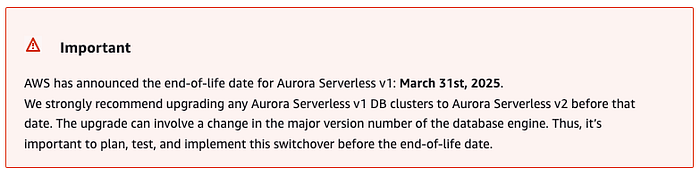
Amazon Web Services (AWS) initially announced the end of life (EOL) for Amazon Aurora Serverless v1, originally effective December 31, 2024. However, AWS has recently extended the EOL date to March 31, 2025 to provide customers with additional time to transition. This change underscores the importance of upgrading to Aurora Serverless v2 while ensuring continued support, improved performance, and cost efficiency. This blog provides detailed information on what this means for your database and how to successfully transition to Aurora Serverless v2 with minimal downtime.
Important Dates for Aurora Serverless v1 EOL
To ensure a smooth transition, AWS has outlined a revised schedule:
- December 2023: AWS notified all Aurora Serverless v1 customers of the upcoming EOL, allowing 12 months for migration.
- September 1, 2024 (Revised): AWS no longer supports creating new Aurora Serverless v1 clusters or instances via the AWS Console or CLI.
- December 31, 2024 (Revised): Aurora Serverless v1 will reach the end of life. From this date, any remaining Aurora Serverless v1 clusters will be automatically upgraded to Aurora Serverless v2 during the next maintenance window.
- January 8, 2025: Customers will no longer be able to create new Aurora Serverless v1 clusters or instances with either the AWS Management Console or the CLI.
- March 31, 2025: Aurora Serverless v1 will officially reach the end of life. After this date, any remaining Aurora Serverless v1 clusters will be automatically upgraded to Aurora Serverless v2 during the next maintenance window.
Clarifications on EOL for Aurora MySQL-Compatible Provisioned Clusters
It is important to understand that Aurora Serverless v1's EOL doesn’t apply to provisioned Aurora clusters. The Amazon Aurora MySQL-Compatible Edition version 2, compatible with MySQL 5.7, reached the end of standard support on October 31, 2024. This deadline only applied to provisioned clusters, so it did not impact Aurora Serverless clusters. However, please note that Aurora Serverless v1 is scheduled for end-of-life (EOL) on March 31, 2025, regardless of the MySQL compatibility version.
It is important to note that if you convert an Aurora Serverless v1 cluster to a provisioned Aurora MySQL cluster after the end-of-life date, any instances running on the older MySQL version (such as MySQL 5.7) may incur extended support charges. For this reason, AWS advises migrating to either Aurora Serverless v2 or an upgraded provisioned Aurora environment before the end-of-life deadline.
Why Is Amazon Aurora Serverless v1 Being Retired?
AWS’s decision to retire Aurora Serverless v1 aligns with its push toward more advanced and efficient serverless technology. While Serverless v1 brought significant flexibility to Aurora databases, Serverless v2 offers greater scalability, better performance, and more refined control.
Here are the primary reasons AWS is shifting focus to Aurora Serverless v2:
- Enhanced Scalability: Serverless v2 supports seamless scaling from hundreds to hundreds of thousands of transactions per second without the need to create new clusters.
- Reduced Latency and Higher Availability: Serverless v2 reduces the warm-up time for scaling events, providing faster responses during high-demand periods.
- Better Compatibility with Aurora Features: Serverless v2 supports features like Global Databases, RDS Proxy, and Multi-AZ with failover support, which were not available in Serverless v1.
What Happens If You Don’t Upgrade by March 31st 2025?
If you don’t upgrade to Aurora Serverless v2 by the EOL, AWS will automatically migrate your clusters during the next maintenance window after March 31, 2025. If your current database version isn’t compatible with Serverless v2, AWS will update your engine to the nearest supported version. To avoid these potential interruptions, AWS encourages customers to upgrade well in advance.
Resources to Help with the Transition
AWS provides several resources to simplify the transition from Serverless v1 to v2. Here are a few key guides:
- Upgrade from Aurora Serverless v1 to v2 with Minimal Downtime: This guide offers a step-by-step process for upgrading your database clusters without significant service disruption.
- Aurora Serverless v2 Requirements: Highlights essential differences and considerations for compatibility between Aurora Serverless v1 and v2.
- Aurora Serverless v2 Upgrade Paths: Details recommended upgrade paths to ensure a smooth transition to Serverless v2.
A Practical Guide for Upgrading from Serverless v1 to v2
The upgrade process from Aurora Serverless v1 to v2 is designed to be as seamless as possible, with tools and resources available to minimize downtime and ensure continuity. Here’s a high-level overview of the process:
1.Review Requirements for Aurora Serverless v2 Compatibility:
- Check your current database engine version and ensure it’s compatible with Serverless v2. If it’s not, plan for a minor version upgrade as part of the migration.
2. Plan for Migration:
- To reduce the potential impact on end-users, schedule the upgrade during off-peak hours or a maintenance window. AWS allows customers to initiate the upgrade anytime before December 31, 2024.
3. Test in a Staging Environment:
- If feasible, deploy a test environment to validate your application’s interaction with Aurora Serverless v2. AWS provides detailed guidelines on setting up a test cluster in their minimal downtime upgrade guide linked above.
4. Initiate the Upgrade:
- Use the AWS Console or CLI to initiate the upgrade process. The upgrade time will vary depending on the size and complexity of your database, so plan accordingly.
5. Monitor the Post-Migration Process:
- After the upgrade, review your database metrics and application logs to ensure everything is functioning as expected.
Best Practices for Testing Your Upgrade
To minimize unexpected issues, it’s advisable to test any migration changes in a staging environment. This practice helps identify compatibility adjustments or configuration changes early, making it easier to address potential problems.
This blog is for AWS Customers and users currently running Amazon Aurora Serverless v1. It helps them understand AWS’s end-of-life plan for Serverless v1 and guides them through a proactive upgrade to Aurora Serverless v2. By outlining key dates, upgrade considerations, and best practices, this guide aims to make the transition smoother and more manageable for users.
With AWS retiring Aurora Serverless v1 by March 31, 2025, now is the time to evaluate your database needs, leverage AWS’s extensive documentation, and begin planning for the upgrade. Upgrading to Aurora Serverless v2 not only ensures uninterrupted service but also provides access to a host of new features, cost efficiencies, and performance improvements that can strengthen your application’s resilience and scalability. Starting early allows you to fully understand the new features in Aurora Serverless v2, test compatibility, and avoid last-minute surprises — setting your environment up for long-term success.
I trust this blog post has provided valuable insights. If you’d like to know more or are interested in our services, don’t hesitate to get in touch. You can contact us here.