

If you’re looking to incorporate multimedia analysis into your applications, then Amazon Rekognition is the ideal solution. This deep learning-based image and video analysis service accurately detects, analyzes, and compares faces, identifies objects, reads printed text, and more. Rekognition is built on AWS, making it highly scalable and capable of processing millions of images or videos in real time.
How Does Amazon Rekognition Work?
With the help of deep learning technology, Amazon Rekognition can analyze images and videos by utilizing convolutional neural networks (CNNs) that can detect and recognize features within the visual data. You can use this service through:
- AWS Management Console
- AWS SDK
- API (some useful samples)
Rekognition’s key features include:
- Object and Scene Detection: This can recognize thousands of different objects and scenes, ranging from everyday items like a car, dog, or tree to broader scene categories like the beach, cityscape, or forest.
- Facial Analysis: Detect, analyze, and compare faces, with the ability to determine attributes such as age range, gender, and emotions.
- Facial Recognition: Search and compare faces in a collection, identifying potential matches or verifying a user’s identity.
- Pathing: Track the movement of people in a video to identify potential security risks or analyze customer behaviour.
- Label Detection: This is a feature that allows you to analyze images and automatically identify objects, scenes, and concepts within them. For example, a photo of people on a tropical beach may contain labels such as palm tree (object), beach (scene), running (action), and outdoors (concept).
- Image Properties: Detects dominant colours and measures image brightness, sharpness, and contrast.
- Video Segmentation: Rekognition can analyze video files and segment them into meaningful scenes or shots. This feature is particularly beneficial for video indexing, content management, and targeted advertising purposes, as it helps users better understand and organize their video content.
- Text Detection: Rekognition is capable of detecting and extracting text from images and videos. This feature enables users to identify written information within visual content, which can be useful for applications like document analysis, license plate recognition, and augmented reality experiences.
- Emotion Detection: The platform can recognize and analyze the emotions displayed by people in images and videos, such as happiness, sadness, anger, or surprise. This feature is valuable for applications in customer experience, advertising, and entertainment, as it enables users to gauge audience reactions or tailor content to evoke specific emotional responses.
- Content Moderation: Rekognition helps users identify and filter out potentially unsafe or inappropriate visual content by automatically detecting explicit or suggestive material. This feature is beneficial for businesses and organizations that need to maintain a safe and secure environment for their users, such as social media platforms, e-commerce websites, or educational institutions.
- Celebrity Recognition: Rekognition can identify thousands of famous personalities across various fields, such as entertainment, sports, and politics. This feature is useful for applications like media analysis, content recommendation, and advertising.
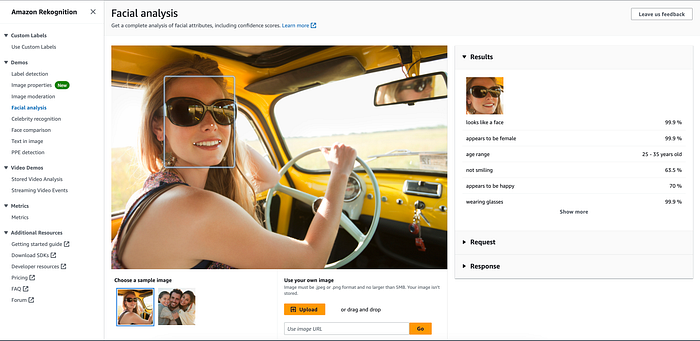
Facial analysis sample sourced from the Amazon Rekognition dashboard in the AWS console
Getting Started with Amazon Rekognition Tutorial
This tutorial will introduce you to Amazon Rekognition’s concept of label detection and guide you through using the AWS Management Console and AWS SDK for Python (Boto3).
Configure AWS CLI environment
- Sign in to your AWS account console if you haven’t already: https://console.aws.amazon.com
- Install the AWS Command Line Interface (CLI) following these instructions: https://docs.aws.amazon.com/cli/latest/userguide/getting-started-install.html
- Configure the AWS CLI with your access key, secret access key, default region and output format:
$ aws configure
AWS Access Key ID [****]:
AWS Secret Access Key [****]:
Default region name [us-east-1]:
Default output format [json]:
Create an Amazon S3 bucket to store your image
- Sign in to the AWS Management Console and open the Amazon S3 console: https://s3.console.aws.amazon.com/s3/
- Click “Create bucket” and follow the instructions to create a new bucket to store your image.
- Upload an image to your newly created S3 bucket.
Set up permissions
Create an IAM role with the required permissions to access the S3 bucket and use Amazon Rekognition, you’ll need to create a JSON policy document for the IAM role. The following is an example policy that grants the necessary permissions:
{
    "Version": "2012-10-17",
    "Statement": [\
        {\
            "Effect": "Allow",\
            "Action": [\
                "rekognition:DetectLabels"\
            ],\
            "Resource": "*"\
        },\
        {\
            "Effect": "Allow",\
            "Action": [\
                "s3:GetObject",\
                "s3:ListBucket"\
            ],\
            "Resource": [\
                "arn:aws:s3:::your-bucket-name",\
                "arn:aws:s3:::your-bucket-name/*"\
            ]\
        },\
        {\
            "Effect": "Allow",\
            "Action": [\
                "logs:CreateLogGroup",\
                "logs:CreateLogStream",\
                "logs:PutLogEvents"\
            ],\
            "Resource": "arn:aws:logs:*:*:*"\
        }\
    ]
}
Note: Replace “your-bucket-name” with the actual name of your S3 bucket.
The above policy allows the IAM role to:
- Use the
DetectLabelsoperation in Amazon Rekognition. - List the contents and read objects from the specified S3 bucket.
- Create and write to CloudWatch Logs, which can be useful for logging and monitoring purposes.
The steps to create the IAM policy using the JSON editor in the AWS console can be followed from this guide here.
Use Amazon Rekognition in Python with Boto3
- Install the boto3 library:
$ pip install boto3
2. Create a new Python file and import the necessary libraries:
import boto3

rekognition_client = boto3.client('rekognition')
3. Write a function to detect objects and scenes in an image:
def detect_objects_and_scenes(bucket, key):
    response = rekognition_client.detect_labels(
        Image={
            'S3Object': {
                'Bucket': bucket,
                'Name': key
            }
        },
        MaxLabels=10,
        MinConfidence=80
    )

    for label in response['Labels']:
        print(f"Label: {label['Name']}, Confidence: {label['Confidence']}")

detect_objects_and_scenes('your-bucket-name', 'your-image-key')
4. Run your Python script.
The output will display the detected objects and scenes in the image along with their confidence scores. In essence, a confidence score is a number between 0 and 100 that indicates the probability that a given prediction is correct. For instance, if an image analysis returns a score of 95 for the label “Smiling” and 20 for the label “Wearing Glasses”, it is highly likely that the person in the photo is smiling but not wearing glasses. For error-sensitive applications, it’s advisable to set a minimum confidence threshold higher than the default to discard false positives and optimize the user experience.
This is only the beginning of what Amazon Rekognition has to offer, including features such as facial recognition, text detection, the ability to moderate unsafe content and much more. To explore further, visit the official Getting Started with Amazon Rekognition documentation.
Real-world Use Cases of Amazon Rekognition
Marketing and Advertising: Businesses can use Rekognition to analyze customer preferences and deliver targeted advertisements. Rekognition can identify popular objects, activities, and scenes from images and videos shared on social media, which helps marketers better understand consumer interests and preferences. This valuable information can then be used to create personalized marketing campaigns that truly resonate with customers.
Social Media Management:As a social media manager, utilizing Rekognition can be a valuable tool in moderating user-generated content to align with community guidelines and brand standards. The content moderation feature offered by Rekognition has the ability to automatically identify explicit or suggestive content, thus preventing its publication. Moreover, it can analyze user engagement by detecting facial expressions in response to content, allowing businesses to gain insight into their audience's perception of their brand.
Finance and Banking: Financial institutions can enhance customer experiences and prevent fraud by utilizing Rekognition. With the integration of facial recognition technology into their mobile banking apps, banks can verify users without the hassle of passwords or security questions. Additionally, the text detection feature can extract valuable information from documents like loan applications and ID cards, streamlining data entry and minimizing human error.
Retail and E-commerce: Retailers have the opportunity to leverage Rekognition to analyze shopper behaviour and enhance store layouts. With the ability to monitor customer movement within a store, Rekognition is able to identify areas and products that are popular, providing retailers with valuable insights to make informed decisions on product placement and store design. E-commerce platforms can also benefit from Rekognition's object and scene detection functionalities, allowing for automatic categorization and tagging of product images, ultimately simplifying the customer's search for desired products.
Security and Surveillance: Rekognition can enhance security systems by detecting and analyzing faces in real time. The feature of facial recognition can identify individuals of interest, verify the identities of employees at access points, or keep a watchful eye on crowds for any questionable behaviour. Furthermore, its pathing capability can track people's movements in a video, allowing security staff to detect potential threats and respond promptly. As an example, the Boston Marathon terrorist attack in 2013 led to one of the largest and most intense manhunts in US history. It took law enforcement agencies three days to identify the perpetrators, which allowed the culprits time to evade arrest straight after the incident. Had the Amazon Rekognition technology been available and in use during that time, it could have quickly processed and analyzed the vast amounts of surveillance footage captured from multiple sources during the marathon. By detecting, recognizing, and tracking the culprits in real time, Rekognition could have expedited the identification process, enabling authorities to apprehend the individuals much more swiftly.
Benefits and Ethical Concerns of Amazon Rekognition
Benefits
- Ease of Use: It is designed to be user-friendly, making it simple for developers to integrate image and video analysis into their applications.
- Scalability: Built on AWS, it can handle large-scale projects, processing millions of images or videos in real time.
- Accuracy: It leverages advanced deep learning algorithms to provide accurate and reliable results.
- Real-time Analysis: It is capable of processing images and videos in real time, allowing businesses to respond promptly to events or derive insights from data as it is generated.
- Customization: It allows users to train custom models, enabling the service to recognize specific objects, scenes, or activities relevant to a particular industry or use case.
- Automatic Feature Updates: As AWS continues to develop and enhance Rekognition, new features and improvements are automatically made available to users, ensuring that they always have access to the latest capabilities without any additional effort.
- Robust Documentation and Support: AWS offers comprehensive documentation, sample code, and tutorials for Rekognition, enabling developers to quickly learn and implement the service. Additionally, AWS provides a range of support options, including forums, webinars, and technical support, to assist users in overcoming any challenges they may face while using the platform.
Ethical Concerns
- Privacy: The use of facial recognition technology raises privacy concerns, as it may enable unauthorized surveillance or tracking of individuals without their consent. Businesses and organizations using Rekognition should ensure that they adhere to relevant privacy regulations and guidelines.
- Bias: AI algorithms, including those used by Rekognition, may exhibit bias in their predictions based on the training data they are fed. This can lead to unfair treatment of certain demographic groups or individuals. It is essential for developers and organizations to be aware of potential biases in the data they use to train Rekognition and to continually monitor the service’s predictions to mitigate potential issues.
- Transparency: Ensuring transparency in the use of AI technology, such as Rekognition, is crucial. Organizations should be open about their use of the service and communicate the reasoning behind their decisions based on the platform’s analysis. This transparency helps build trust and confidence among stakeholders, including customers, employees, and regulators.
Amazon Rekognition Pricing
Rekognition follows a pay-as-you-go pricing model, with separate costs for image and video analysis. The service provides a free tier with a limited number of monthly images and minutes of video analysis, making it accessible for users to try the service without incurring charges. Beyond the free tier, its charges are based on the number of images or minutes of video analyzed, the number of faces stored in a collection, and the number of text detections made.
For a detailed breakdown of pricing, you can visit the Amazon Rekognition Pricing page and the AWS Pricing Calculator, a web-based planning tool that can be used to create estimates.
Conclusion
Amazon Rekognition stands at the forefront of AI-based image and video analysis technology, offering a multitude of benefits to AWS customers. By harnessing the power of deep learning algorithms, Rekognition delivers cutting-edge capabilities that can revolutionize various industries and applications. From marketing to security and beyond, this service is poised to provide AWS customers with unparalleled insights and automation, streamlining their operations and enhancing decision-making.
By carefully considering the ethical implications of using Rekognition and following guidelines, organizations can unlock the full potential of this advanced platform while ensuring they respect individual rights and promote fairness. As AI technology continues to evolve, Amazon Rekognition remains an invaluable resource for businesses looking to stay ahead of the curve and capitalize on the benefits of AI-powered image and video analysis.
With a specialisation in AWS, I primarily work as a Cloud Architect, focusing on infrastructure modernisation.
[Resolving the “Your current user or role does not have access to Kubernetes objects” Problem on AWS…\ \
Jun 18, 2023
[Building AWS Architecture with MCP Servers and Strands Agents\ \
Sep 22, 2025
[JA3 and JA4 Fingerprints in AWS WAF and Beyond\ \
Apr 10, 2025
[Transforming Your Startup into a Success Story with AWS and DoiT\ \
May 5, 2023
[Stanford Just Killed Prompt Engineering With 8 Words (And I Can’t Believe It Worked)\ \
Oct 19, 2025
[A clap icon25K\ \
[10 Must-Have Skills for Claude (and Any Coding Agent) in 2026\ \
Mar 9
[A clap icon1K\ \
[I Stopped Using ChatGPT for 30 Days. What Happened to My Brain Was Terrifying.\ \
Dec 28, 2025
[A clap icon12.1K\ \
[I Woke Up at 4:30 AM Every Day for 30 Days — Here Is What Nobody Tells You\ \
Mar 7
[A clap icon5K\ \
[Why Thousands Are Buying Mac Minis to Escape Issues with Big Tech AI Subscriptions Forever |…\ \
Feb 15
[A clap icon5.8K\ \
[As a Neuroscientist, I Quit These 5 Morning Habits That Destroy Your Brain\