
Cloud cost optimization services
Cloud costs grow easily. Visibility doesn't.
Growing cloud spend isn't the problem. The problem is not knowing what's driving it, not catching waste before it compounds, and not having the tools to act quickly when something changes. That's the gap DoiT closes.
Trusted by platform engineering teams


Saved via automated compute optimization
Cost reduction through rightsizing
Monthly AWS cost reduction
The challenge
Why cloud costs keep climbing even when you're paying attention
Most engineering teams aren't ignoring cloud spend. The problem is that the tools available are built to show you what happened, not what's happening right now or what to do next.
You can see the total bill, not what's driving it
When costs spike, tracing the cause across services, accounts, and regions becomes a time-consuming investigation. By the time you find it, you've already paid for it.
Commitment management becomes a full-time job
Reserved Instances and Savings Plans require forecasting workloads that keep changing. Get it wrong and you either overpay on-demand or lock into coverage that no longer fits.
Rightsizing feels risky without deep visibility
Reducing instance sizes without clear utilization data feels like gambling with reliability. Most teams leave the waste in place instead of risking customer impact.
Multi-cloud makes everything harder
If your infrastructure spans AWS, Google Cloud, or Azure, maintaining a unified view of spend and acting on it is operationally complex in ways native billing tools don't solve.
What optimization involves
What cloud cost optimization means in practice
Cloud cost optimization isn't a one-time project. Done well, it keeps visibility, automation, and expertise working together all the time.
Visibility
A single real-time view of spend across cloud accounts, services, and teams, mapped to business context so the numbers are actionable instead of just informative.
Automation
Commitment management, anomaly detection, and rightsizing require continuous analysis of patterns that no human team can manage manually at scale.
Expertise
Tooling surfaces opportunities. Experienced architects help decide which actions fit your architecture, workloads, and growth plans.
How DoiT helps
What you get when you work with DoiT
DoiT combines a FinOps-certified platform with a global team of cloud architects, so optimization does not fall entirely on your engineering team.
Unified cost visibility
Cloud Analytics gives teams one shared real-time view across AWS, GCP, and Azure, with allocation by product, team, or customer. Proof: 77% cost reduction at Skyral.
Automated commit management
Flexsave for Compute continuously optimizes coverage without asking your team to manage reservations by hand. Proof: $200K+ saved at Sliide.
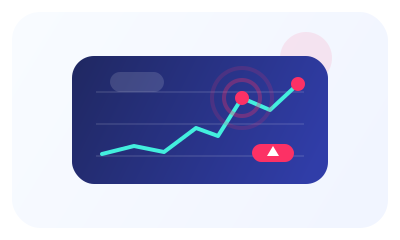
Real-time anomaly detection
Unexpected cost spikes get flagged the moment they appear so teams can act before waste compounds. Proof: Felix Pago found $30K per month in Firestore waste the same day.
Kubernetes rightsizing
PerfectScale helps teams rightsize Kubernetes safely, with guardrails that protect reliability while improving efficiency.
FinOps workflow automation
CloudFlow helps automate tagging policies, budget alerts, and governance workflows so cost controls stay consistent as the environment evolves.
Expert-led workshops
DoiT architects deliver a prioritized action plan ranked by ROI and effort, tailored to your environment instead of a generic checklist. Proof: Atadex reduced AWS costs by 25%+.
Cloud coverage
Wherever you run cloud, DoiT has coverage
DoiT supports AWS, Google Cloud, Azure, and the teams operating across all three with one optimization approach and one shared view of spend.
Amazon Web Services
Support for AWS customers across commitment management, architecture review, anomaly detection, and day-to-day cost governance.
Google Cloud
Deep Google Cloud expertise across BigQuery, GKE, Compute Engine, and other high-spend services where visibility and optimization matter most.
Microsoft Azure
The same real-time visibility and optimization model extends to Azure, making DoiT a practical option for multi-cloud environments.
What teams like yours have been able to do
See all customer stories

How it works
From first call to first optimization, what to expect
If you've worked with consultants who required months of onboarding, DoiT works differently.
Connect and see your data
Your cloud accounts connect to DoiT Cloud Intelligence so your team can see its first spend insights quickly.
Identify highest-ROI opportunities
The platform surfaces optimization recommendations ranked by savings potential and implementation effort.
Automate what can be automated
Commit management, anomaly detection, and rightsizing run continuously so savings do not depend on manual follow-up.
Review strategy continuously
DoiT's cloud architects stay involved with ongoing check-ins and strategic guidance as your environment evolves.
Cloud cost management as a FinOps practice
The most durable reductions come from treating cloud spend as a financial discipline, not just an engineering problem. DoiT brings a FinOps-certified platform and practitioners who help teams turn that discipline into day-to-day action.
Our FinOps capabilitiesCertified
FINOPS
Experts
72
Platform
FOCUS
How DoiT is different
How DoiT compares to cloud cost management tools
Native billing consoles show aggregate spend. Point tools solve one slice of the problem. DoiT combines platform depth, cloud coverage, and expert support in one operating model.
Platform and expertise combined
Most tools are self-serve software. DoiT pairs its platform with cloud architects who can help with reviews, workshops, and implementation trade-offs.
A single view across clouds
Teams working across AWS, Google Cloud, and Azure get one place to see, analyze, and act on spend instead of three disconnected consoles.
Automation for the decisions that matter
Commitment management, rightsizing, and anomaly response are handled continuously instead of being left as static recommendations for teams to chase later.
Frequently asked
questions
How do I know if I am overpaying for cloud?
Common signs include a bill that keeps rising without a clear service-level explanation, low utilization on expensive compute, commitment coverage that no longer matches usage, and spikes you discover from reports instead of in real time.
What's the difference between cloud cost optimization and FinOps?
Cloud cost optimization refers to the technical actions, such as rightsizing, commitment management, and waste removal. FinOps is the wider operating model that brings finance, engineering, and product into shared accountability for cloud spend.
How long does it take to start seeing results?
Most teams see their first optimization insights within days of connecting accounts. Automated savings begin showing up early, while larger reductions usually come from combining quick wins with architecture improvements over the first few weeks.
Does DoiT work with AWS, Google Cloud, and Azure?
Yes. DoiT supports all three major cloud providers and is especially valuable for teams that need one operational view across multiple clouds.
What's included in a cloud cost optimization workshop?
A workshop starts with a review of your architecture, spend patterns, and growth plans. DoiT then delivers a prioritized set of recommendations ranked by ROI and implementation effort, specific to your environment.
Is DoiT only for large enterprises?
No. The platform and expert support are useful for companies at a wide range of stages, from fast-growing startups to mature multi-cloud teams with more complex governance needs.
Can I try DoiT before committing?
Yes. A demo can walk through the platform with real use cases and show how DoiT approaches visibility, savings automation, and expert guidance.
Ready to stop paying for cloud you're not using?
Your engineers have better things to do than chase billing anomalies.